
Kinsta and Pressable are both premium managed WordPress hosts, but the experience feels noticeably different once you start using them.
Kinsta is built around performance and control. You get strong infrastructure, but many things come as add-ons, so your final cost depends on how you configure it.
Pressable takes the opposite approach. Most features are already included, pricing is simpler, and scaling feels more predictable without constantly thinking about extras.
This comparison breaks down what really matters when you’re choosing between them. You’ll see where each one wins, where it falls short, and which one actually makes sense for your type of site.
Kinsta vs Pressable Comparison Table
| Feature | Kinsta | Pressable |
|---|---|---|
| Starting Price | $30/month | $20.83/month |
| Pricing Model | Visit-based + add-ons | Fixed pricing, most features included |
| Infrastructure | Powerful cloud infrastructure | WP Cloud (Automattic infrastructure) |
| Architecture | Isolated container per site (dedicated resources) | Distributed cloud grid with failover |
| Data Centers | 27 global data centers | 4 WP-specific |
| CDN | Included (Cloudflare, 300+ edge locations) | Global CDN included |
| Scalability | Manual scaling + paid add-ons | Automatic scaling + failover |
| Traffic Handling | Stable but limited by visits | Handles spikes better (autoscaling) |
| PHP Resources | Limited per plan (upgrade needed) | High PHP workers included |
| Bandwidth | Metered (based on visits) | More flexible / less strict |
| Caching | Server-level + edge caching | Edge + object + persistent caching |
| Redis Cache | Paid add-on (~$100/month) | Included |
| Backups | 6 types (daily, hourly add-on, manual, external) | Daily + hourly + on-demand included |
| Backup Frequency | Daily (hourly paid) | Hourly + daily included |
| Staging | 1 free + premium staging (paid) | Multiple staging sites included |
| Sandbox Sites | Not available | Included |
| Migrations | Free expert migrations | Free migrations |
| Multisite Support | Available on higher plans | Included on higher plans |
| Developer Tools | SSH, Git, WP-CLI, API, APM tool | SSH, Git, WP-CLI |
| APM Tool | Built-in performance monitoring | Not included |
| Database Optimization | Automatic MySQL optimization | Included caching optimizations |
| Uptime SLA | 99.9% SLA (up to 99.99% infra reliability) | 100% uptime guarantee |
| Failover System | Cloud redundancy | Automatic data center failover |
| Security | WAF, DDoS protection, malware removal, isolation | Jetpack security, WAF, instant patching |
| SSL | Free SSL | Free SSL |
| Malware Removal | Free | Included |
| Automatic Updates | Paid add-on ($3/month) | Included |
| Email Hosting | Not included | Add-on available |
| Add-ons | Many (Redis, backups, disk, PHP, etc.) | Very few needed (most included) |
| Disk Scaling | Paid add-on | Included in plans |
| Visit Limits | Strict limits (overage charges apply) | More flexible limits |
| Overage Charges | Yes (visits, CDN, disk) | Rare |
| Dashboard | MyKinsta (clean, developer-focused) | Pressable dashboard (simpler) |
| Ease of Use | Slight learning curve | Easier for beginners |
| Support | 24/7 expert-only chat, very fast | 24/7 support + optional Slack |
| Support Quality | Highly technical | Good but less specialized |
| Best For | Performance-focused sites, developers, control | Agencies, multiple sites, predictable pricing |
| Trustpilot Reviews | 4.8/5.0 (1k+ reviews) | 4.6/5.0 (290+ reviews) |
| G2 Reviews | 4.8/5.0 (1400+ reviews) | 4.8/5.0 (180+ reviews) |
About of Kinsta and Pressable
Kinsta
Kinsta is a premium managed WordPress host built for speed, stability, and control. It runs on powerful cloud infrastructure and is designed to handle everything from small sites to high-traffic projects without performance drops.
You get access to 27 global data centers, so you can place your site close to your audience for faster load times. It also uses a global CDN with 300+ locations, which helps deliver content quickly worldwide.
The platform is very performance-focused. Each site runs in its own isolated environment, and you also get built-in tools like APM monitoring, staging, and developer features. This makes it a strong choice if you care about speed and technical control.
Pressable
Pressable is also a managed WordPress host, but it’s built on WP Cloud, the same infrastructure behind WordPress.com. That gives it a strong advantage in reliability and WordPress-specific optimization.
Its biggest strength is simplicity. Most features are already included, like automatic updates, daily backups, built-in security, and a global CDN. You don’t need to rely on add-ons to unlock core functionality.
The platform is designed to scale automatically. If traffic spikes, the system adjusts without manual upgrades, and its architecture removes single points of failure by shifting load across servers.
In short, Pressable focuses more on ease, bundled features, and hands-off management, especially useful if you manage multiple sites or client projects.
Performance and Speed
Kinsta and Pressable both use managed WordPress infrastructure, but their performance setups take different approaches.
| Performance factor | Kinsta | Pressable |
|---|---|---|
| Server environment | Isolated LXC containers | Automattic WP Cloud |
| Server technology | Nginx + MariaDB on C2/C3D VMs | WP Cloud with auto-scaling |
| Page caching | Server-level full-page cache | Full-page Edge Cache |
| Object caching | Optional Redis | Object cache |
| PHP | PHP workers allocated per site | Auto-scaling PHP resources |
| PHP caching | OPcache | OPcache |
| Extra performance features | Edge Cache, server-level cache | Geo-redundant setup, auto-scaling, Edge Cache |
Kinsta gives each site its own isolated LXC container. Nginx handles web requests, while MariaDB handles the database. Its server-level cache can serve cached pages without sending every request through PHP.
Pressable runs on Automattic’s WP Cloud platform. It uses full-page Edge Cache, object caching, OPcache, and auto-scaling to handle traffic increases without relying on a fixed resource ceiling.
The two setups have different strengths:
- Kinsta has stronger raw server hardware allocation.
- Pressable has faster front-end response in recent independent testing.
- Kinsta offers optional Redis for object caching.
- Pressable has auto-scaling built into its platform.
- Both use full-page caching to reduce repeated WordPress processing.
Your WordPress setup also affects speed. A lightweight theme keeps pages smaller, while a good cache can reduce server work. Fast WordPress themes can help with page weight, and WordPress caching plugins are useful when your hosting setup supports them.
Time to First Byte (TTFB)
TTFB measures how quickly the server starts sending a response after a visitor requests a page. Lower is better.
The latest independent monitoring, covering October 2025 through May 2026, recorded:
- Pressable: 320 ms
- Kinsta: 525 ms
- Difference: 205 ms in Pressable’s favor
Pressable’s TTFB ranged from 252 ms to 523 ms during the monitoring period. Kinsta’s 525 ms average puts it above the 465 ms field median used in the same test.
For visitors, both hosts start responding in less than one second. Pressable’s lower result means the browser gets the first response sooner, which gives the page a quicker start.
Kinsta does have strong underlying hardware. Its WPBench score was 8.8, compared with 6.7 for Pressable. That matters more for uncached requests, complex database work, and resource-heavy WordPress sites.
If your site is still slow after the server is performing well, WordPress speed tips can help with the other parts of the setup.
Uptime
Pressable has the stronger recent uptime record.
From October 1, 2025, through May 31, 2026:
- Pressable: 100% uptime
- Kinsta: 99.98% uptime
- Pressable: 0 outages
- Kinsta: 4 outages
Pressable maintained 100% uptime across more than 243 days of continuous monitoring. Kinsta recorded 99.98% uptime during the same period.
The difference is small, but 99.98% uptime still allows for roughly 1 hour 45 minutes of downtime across a year if that rate stayed constant.
Kinsta’s uptime history also shows a strong record in earlier years. It recorded 99.999% uptime in 2024, with only 3 minutes of downtime. The 2025 figure fell to 99.97%, partly due to Cloudflare-related incidents.
Pressable backs its service with a 100% network uptime SLA, while Kinsta offers up to a 99.99% SLA.
Which is faster, Kinsta or Pressable?
Pressable wins the speed comparison based on the latest independent data.
The main numbers are clear:
- Pressable TTFB: 320 ms
- Kinsta TTFB: 525 ms
- Pressable load-test response: 12 ms
- Kinsta load-test response: 40 ms
- Pressable uptime: 100%
- Kinsta uptime: 99.98%
Kinsta’s advantage is raw server hardware. Its 8.8 WPBench score is well ahead of Pressable’s 6.7, so Kinsta can make more sense for sites with heavy database work, complex plugins, custom PHP, or large WooCommerce catalogs.
For normal blogs, business websites, and content-heavy WordPress sites, Pressable should generally feel snappier because its TTFB and load-test results are lower.
So, if you’re mainly after faster day-to-day response and strong uptime, I’d pick Pressable. If your site sends a lot of uncached requests or needs more raw CPU, memory, and database performance, Kinsta has the stronger hardware underneath.
Security
Core security protection
Kinsta runs continuous monitoring with checks every 3 minutes, which means your site is checked 480 times per day. It also includes firewall protection, DDoS protection, IP blocking, and automatic bans for suspicious activity.
Pressable also includes firewall protection and real-time monitoring, backed by WP Cloud infrastructure. It combines this with Jetpack-powered protection, including brute force protection and activity monitoring.
Malware and hack handling
Kinsta offers a 100% free hack fix guarantee. If your site is compromised, their team cleans it up without any additional cost.
Pressable includes malware scanning and removal as part of its platform. Security scans run automatically, and cleanup is handled without requiring external tools.
Updates and backups
Kinsta provides daily automatic backups with a 14-day retention on lower plans and up to 30 days on higher plans. Hourly backups are available as a paid add-on.
Pressable creates a full site backup every 24 hours, while the database is backed up hourly. All backups are stored for at least 30 days.
For updates, Kinsta offers automatic plugin updates as a paid add-on, while Pressable includes automatic WordPress core and plugin updates in all plans.
Site architecture (isolation vs shared)
Kinsta uses isolated container-based architecture, meaning each site runs in its own environment with dedicated resources. This prevents cross-site contamination and improves overall security.
Pressable uses a distributed WP Cloud system rather than strict isolation. It focuses on platform-level security and redundancy instead of separating each site into its own container.
Ease of Use and Dashboard
Dashboard experience
Kinsta uses the MyKinsta dashboard. It’s clean, fast, and built with developers in mind. You get detailed controls for things like caching, redirects, backups, staging, and even performance monitoring in one place.
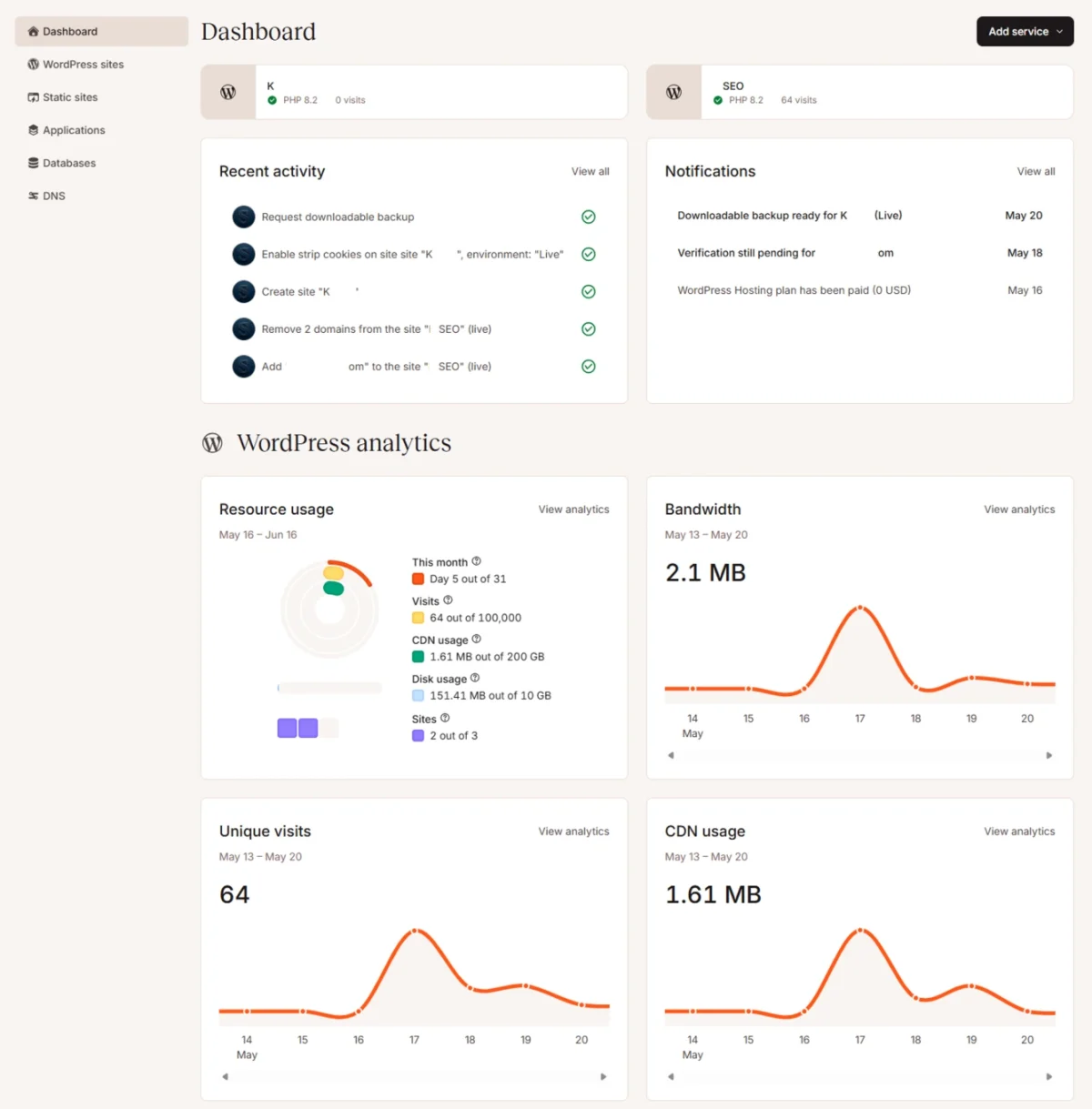
Pressable’s dashboard is simpler and more straightforward. It focuses on managing multiple sites easily, which is why it’s popular with agencies and freelancers handling client projects.

Setup and daily use
Kinsta feels polished, but it takes a little time to get comfortable. There are more options, more settings, and more control, which can feel slightly overwhelming at first.
Pressable is easier right away. Most things are pre-configured, so you don’t need to think much about setup. You can launch and manage sites without digging into technical settings.
Site management
Kinsta is built for control per site. You manage each site with detailed settings, including staging, backups, CDN, and performance tools.
Pressable is built for managing multiple sites together. You can handle updates, backups, and access across sites without jumping through too many screens.
Developer vs beginner experience
Kinsta clearly leans toward developers or users who want more control. Features like SSH access, staging environments, and built-in APM make it more powerful.
Pressable is better if you don’t want to deal with technical details. It handles updates, caching, and optimization automatically, so the dashboard stays simple.
Support Comparison
Support is one of the biggest differences between these two, especially once something actually breaks.
Kinsta support
Kinsta runs a 24/7 support system that’s completely chat-based inside the dashboard. You’re not talking to random agents, every conversation connects you directly with a WordPress engineer.
Response time is one of its strongest points. Most replies come in under 2 minutes, and there’s no ticket queue or escalation layers slowing things down.
They also have a high satisfaction rate, around 98%, which shows how consistent their support quality is.
Another important detail is that there’s no tiered support. You don’t get passed around. The person you talk to can actually fix the issue right away.
The only limitation is there’s no phone support. Everything happens through chat, which works well for technical issues but might not suit everyone.
Pressable support
Pressable also offers 24/7 support, but the experience is slightly different.
You get live chat, ticket support, and even Slack support on higher plans, which is useful if you’re managing multiple client sites. It’s more flexible in terms of communication compared to Kinsta.
The support team is solid and knowledgeable, especially for WordPress-related issues, but response time is not as consistently fast as Kinsta.
Where Pressable stands out is agency support. If you’re handling multiple sites, their workflow and support system feel more aligned with that setup.
Scalability and Growth
Scaling approach
Kinsta uses a plan-based system with fixed limits. For example, entry plans start at 25,000 visits and scale up to millions on higher tiers. If your traffic crosses the limit, you’ll pay overage fees or move to the next plan.
Pressable doesn’t rely on strict visit limits in the same way. Its platform is designed to adjust resources automatically, so your site can handle traffic increases without immediate upgrades.
Resource handling
Kinsta gives you more control, but scaling often means paying for extras. Redis caching costs around $100/month, hourly backups are paid, and PHP workers increase only with higher plans.
Pressable includes most of these resources by default. Object caching, higher resource allocation, and automatic scaling are already part of the plan, so you don’t need to unlock features as you grow.
Growth flexibility
Kinsta works best when your growth is steady and predictable. You know exactly what your plan can handle, but scaling requires manual decisions.
Pressable is more flexible when traffic is unpredictable. Its distributed system spreads load across servers, which helps during sudden spikes without hitting hard limits.
Multi-site expansion
Kinsta is more focused on individual site performance. You can scale multiple sites, but each one is tied to plan limits.
Pressable is built for handling multiple sites. Higher plans support more installs, which makes it easier for agencies or anyone managing client projects.
Pros and Cons
Kinsta Pros
- Strong and consistent performance with isolated containers
- 27 data centers for better location control
- Global CDN with 300+ edge locations
- Very fast support with ~2 minute response time
- Built-in APM tool for performance monitoring
- Free hack fix guarantee
Kinsta Cons
- Higher starting price ($30/month)
- Strict visit limits (overage charges apply)
- Many features cost extra (Redis ~$100/month, hourly backups, etc.)
- Automatic plugin updates are paid add-on
- Limited sites per plan
Pressable Pros
- Lower starting price (~$20.83/month yearly)
- Automatic scaling handles traffic spikes better
- Hourly + daily backups included
- Automatic WordPress and plugin updates included
- Object caching and performance features included
- Supports multiple sites on plans
- 100% uptime guarantee
Pressable Cons
- Only 4 origin data centers
- Smaller CDN network compared to Kinsta
- Slightly slower support response in comparison
- Less control over advanced configurations
- No built-in APM tool
Use Case: Who Should Choose What
Choose Kinsta if:
- You want full control over performance, caching, and environment
- You run high-traffic or global sites and want to use 27 data centers
- You need developer tools like SSH, staging, and built-in APM
- You prefer isolated environments for better stability and security
- You’re okay paying extra for add-ons to fine-tune performance
Choose Pressable if:
- You want simple hosting that works without extra setup
- You manage multiple sites or client projects
- You prefer automatic scaling instead of manual upgrades
- You want more features included (hourly backups, updates, caching)
- You want predictable pricing without worrying about add-ons
Pricing and Plans
Pressable is cheaper than Kinsta for a single WordPress website. Pressable’s Signature 1 plan costs $25 per month or $20.83 per month with annual billing. Kinsta’s Launch plan costs $35 per month or $30 per month with annual billing.
Here’s how their entry-level plans compare:
| Feature | Kinsta | Pressable |
|---|---|---|
| Monthly price | $35/month | $25/month |
| Annual price (monthly equivalent) | $30/month | $20.83/month |
| WordPress websites | 1 | 1 |
| Storage | 15 GB | 20 GB |
| Traffic allowance | 75,000 visits/month | 30,000 visits/month |
| Backups | Daily with 14-day retention | Daily with 30-day retention |
If you’re watching your budget, Pressable is the better deal. You pay less and get more storage on its entry-level plan. Kinsta makes more sense if its hosting features and dashboard suit your needs better.
One more thing: if you’re planning to go with Kinsta, check my Kinsta Black Friday Deals guide before signing up. You could save 50% during the Black Friday sale.
Alternatives to Kinsta and Pressable
If you’re still unsure, check the following alternatives.
WP Engine
WP Engine is the closest alternative to both Kinsta and Pressable. It offers managed hosting with strong performance, staging, and developer tools, but with more bundled features compared to Kinsta.
If you’re comparing it directly, you can check the detailed breakdown between Pressable and WP Engine, or see how it compares against Kinsta in a full WP Engine vs Kinsta comparison.
Cloudways
Cloudways is a different kind of alternative. It’s not fixed-plan hosting, instead you choose your cloud provider and scale resources based on your needs.
It’s much more flexible and cost-effective, especially if you’re trying to avoid strict visit limits. If you want to see how it performs against a premium host, the Cloudways vs Kinsta comparison gives a clear picture.
Rocket.net
Rocket.net is a managed WordPress hosting platform focused on speed, security, and edge-based content delivery. It combines its managed hosting infrastructure with Cloudflare Enterprise, including edge caching and a global network.
It can be a good alternative if you want fast WordPress hosting with features such as Redis, unlimited PHP workers, free migrations, daily backups, and built-in security without having to configure everything yourself.
Check this too: Rocket.net vs Kinsta
Here are the other comparisons worth checking: Pressable vs WPX, Kinsta vs WPX
Final Verdict
If you look at everything together, this isn’t a case where one platform is “better” overall. It depends on how you actually plan to use your hosting.
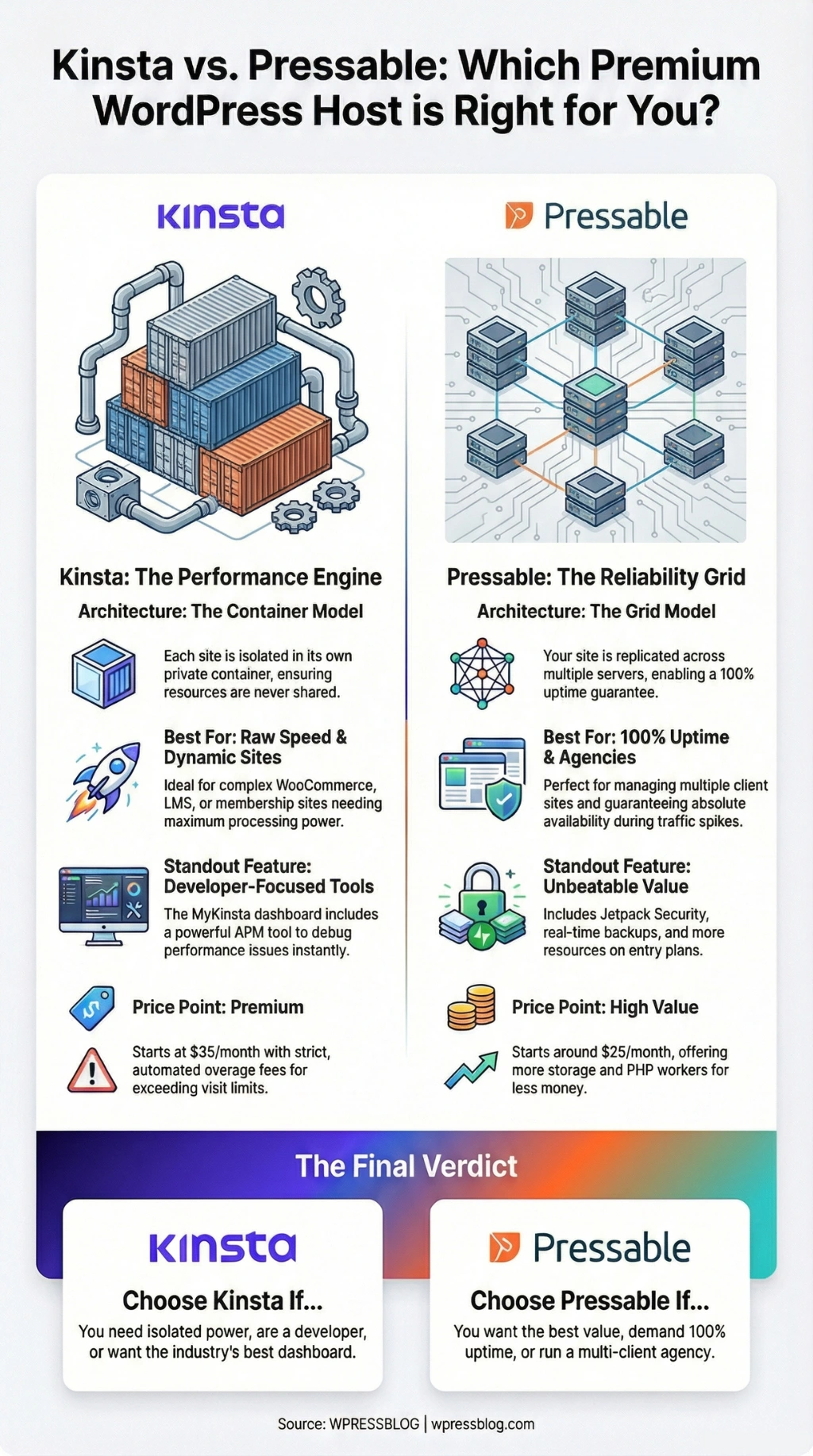
Kinsta is clearly built for performance, control, and consistency. Its isolated container setup, 27+ global data centers, and strong backend performance make it a better fit for serious projects where stability matters. It’s also the stronger choice if you care about developer tools and predictable performance under load.
Pressable, on the other hand, focuses on simplicity and scaling. Its distributed grid system, automatic resource handling, and 100% uptime guarantee make it easier to manage, especially when traffic is unpredictable or growing fast.
- Choose Kinsta if you want maximum control, stronger isolation, and consistent performance
- Choose Pressable if you want easier scaling, more included features, and less manual work
If you’re still unsure, you can also look at some strong Kinsta alternatives before deciding.
FAQs
Is Pressable better than Kinsta?
Not overall. Pressable is better for simplicity, automatic scaling, and bundled features. Kinsta is better for performance control, isolation, and consistent speed.
Which hosting is faster?
Both are fast enough for real-world use. Kinsta is more consistent due to isolated containers, while Pressable performs better during traffic spikes because of its distributed system.
Which one is cheaper long-term?
Pressable is usually cheaper because more features are included. Kinsta can get expensive over time due to add-ons like Redis, hourly backups, and overage charges.
Does Kinsta have better data centers?
Kinsta offers 27 data centers, which gives you better location control. Pressable has 4 origin data centers but relies more on edge delivery and distribution.
Which is better for multiple websites?
Pressable is better for multiple sites since its plans support more installs and shared resources. Kinsta is more focused on individual site performance.
Is Kinsta worth the higher price?
Yes, if you need stable performance, developer tools, and strong isolation. If you don’t need that level of control, Pressable offers better overall value.
Amazing work you have done on this content.
Thank you for knowledge full blog.