
Pressable is more straightforward when you first start using it. The dashboard is clean, the setup process is simple, and most things work without needing much technical knowledge. It’s clearly built for people who want managed WordPress hosting without spending time managing servers or tweaking settings.
WP Engine takes a different approach. It gives you more control, stronger developer tools, and deeper performance features, but it can also feel stricter and more expensive once your site starts growing. Some users love that level of control. Others feel boxed in by plan limits and extra costs.
So this comparison is not really about which hosting company looks better on paper. It’s about which one actually makes more sense for the kind of website you run and the way you prefer to manage it.
Before getting into performance, pricing, support, and real-world differences, let’s quickly compare Pressable and WP Engine side by side.
Pressable vs WP Engine: Detailed Comparison (All Features)
| Feature | Pressable | WP Engine |
|---|---|---|
| Hosting Type | Fully managed WordPress hosting | Fully managed WordPress hosting |
| Infrastructure Provider | WP Cloud powered by Automattic | Google Cloud + AWS infrastructure |
| Starting Price | $20.83/month | $27/month |
| Free Trial | No | No |
| Money back guarantee | 30 days | No |
| Websites on Entry Plan | 1 website | 1 website |
| Monthly Visit Limit | 30,000 visits | 25,000 visits |
| Storage on Entry Plan | 20 GB SSD | 10 GB SSD |
| Bandwidth | Unmetered | 75 GB/mo |
| CDN Provider | Global CDN included | Cloudflare Enterprise CDN |
| Edge Caching | Yes | Yes |
| Average Global TTFB | ~180–350 ms | ~120–250 ms |
| Average Fully Loaded Speed | ~1.2–2.0 sec | ~0.9–1.8 sec |
| Core Web Vitals Performance | Good | Very strong |
| Uptime Guarantee | 100% network SLA | 99.95% SLA |
| Real World Uptime Reputation | Very stable | Extremely stable |
| Data Center Locations | 4 data centers | 20+ data centers |
| PHP Workers Efficiency | Good | Better under heavy load |
| Traffic Spike Handling | Good | Excellent |
| Built-in Caching | Server-side caching | EverCache proprietary caching |
| Object Cache Support | Limited | Better advanced support |
| HTTP/3 Support | Yes | Yes |
| NVMe Storage | Not clearly specified | Not clearly specified |
| Free SSL Certificates | Yes | Yes |
| Automatic Backups | Daily | Daily |
| Backup Retention | 30 days | 60 Days |
| One-Click Restore | Yes | Yes |
| Malware Scanning | Yes | Yes |
| Firewall Protection | Yes | Advanced managed firewall |
| DDoS Protection | Yes | Yes |
| Automatic Plugin Updates | Yes | Smart Plugin Manager available |
| WordPress Core Updates | Automatic | Automatic |
| Staging Environment | Yes | Yes |
| Development Environment | Basic | Advanced |
| Git Integration | Limited | Full Git workflow |
| SSH Access | Yes | Yes |
| SFTP Access | Yes | Yes |
| WP-CLI Support | Yes | Yes |
| Multi-User Collaboration | Yes | Yes |
| Agency Workflow Tools | Good | Excellent |
| White Label Options | Limited | Better agency support |
| WooCommerce Optimization | Good | Strong optimization |
| Dynamic Cache Handling | Average | Better for ecommerce |
| Checkout Performance | Good | Faster under load |
| Database Optimization | Standard | More aggressive optimization |
| Scalability | Medium to high | High to enterprise |
| Enterprise Hosting Options | Limited | Strong enterprise solutions |
| Support Availability | 24/7 support | 24/7 support |
| Live Chat Support | Yes | Yes |
| Phone Support | No | Yes (Except starter plan) |
| Support Quality | Very WordPress-focused | Highly technical experts |
| Average Support Response Time | Fast | Very fast |
| Beginner Friendliness | Easier | Moderate learning curve |
| Dashboard Simplicity | Cleaner and simpler | More feature-heavy |
| Migration Support | Free expert migrations | Free automated migrations |
| Migration Plugin | Yes | Yes |
| Email Hosting | No | No |
| Free Domain | No | No |
| Overage Charges | Less aggressive | Common with traffic spikes |
| Visitor Counting Strictness | Moderate | Strict |
| Plugin Restrictions | Fewer restrictions | Some banned plugins |
| Performance Monitoring Tools | Basic | Advanced monitoring |
| Custom Cache Rules | Limited | Better customization |
| Advanced Security Features | Standard premium security | Enterprise-level security stack |
| Trustpilot Reviews | 4.6/5.0 (290+ reviews) | 4.4/5.0 (1.7k+ reviews) |
| G2 Reviews | 4.8/5.0 (180+ reviews) | 4.6/5.0 (300+ reviews) |
| Best Use Case | Simpler managed hosting | High-performance business hosting |
| Best For Agencies | Good | Excellent |
| Best For Developers | Moderate | Excellent |
| Best For Beginners | Excellent | Good |
| Best For Large Traffic Sites | Good | Excellent |
| Overall Value for Money | Better for smaller sites | Better for scaling businesses |
About Pressable and WP Engine
Pressable
Pressable is like the kind of hosting platform made for people who just want WordPress to work properly without constantly fixing things. The setup is simple, the dashboard is clean, and you don’t get buried under a bunch of technical settings right after logging in.
A big reason people go with Pressable is the Automattic connection. Since it’s backed by the company behind WordPress.com and WooCommerce, the whole platform is closely tied to the WordPress ecosystem instead of feeling like generic web hosting with “WordPress hosting” written on top of it.
It works especially well for freelancers, agencies, business websites, and WooCommerce stores that want managed hosting without needing a developer for every small task.
That said, power users sometimes outgrow it. If you like deep server control, advanced performance tweaking, or highly customized workflows, Pressable can start feeling a little restrictive compared to more developer-focused platforms.
WP Engine
WP Engine is more like a serious performance-focused platform from the moment you start using it. It’s built for websites that need speed, stability, staging tools, developer workflows, and infrastructure that can handle larger traffic without falling apart.
A lot of agencies, developers, and growing businesses choose WP Engine because it gives them more control and stronger optimization tools right out of the box. Things like staging environments, advanced caching, Git integration, and performance monitoring are a much bigger part of the experience here.
But WP Engine also has a reputation for being expensive once your site starts growing. The entry plans look manageable at first, but traffic limits, add-ons, and upgrade pricing catch a lot of users off guard later.
So while WP Engine gives you more power and flexibility, it also expects you to pay for that premium experience.
Performance and Speed
Pressable and WP Engine both use managed WordPress hosting, so much of the performance work happens at the server level rather than through WordPress plugins.
| Performance factor | Pressable | WP Engine |
|---|---|---|
| Infrastructure | Automattic WP Cloud | Google Cloud; AWS or Azure on premium plans |
| Server setup | WP Cloud with geo-redundant primary and secondary systems | Containerized platform with Nginx |
| Page caching | Full-page Edge Cache | EverCache for static and dynamic content |
| Object caching | Object cache | EverCache; Redis available on supported plans |
| PHP | Auto-scaling platform | PHP workers managed by WP Engine |
| PHP caching | OPcache | OPcache |
| Built-in performance features | Edge Cache, object cache, auto-scaling, failover | EverCache, Cloudflare edge caching, auto-scaling |
Pressable keeps the setup fairly simple for the site owner. Its WP Cloud platform handles page caching, object caching, OPcache, and scaling at the platform level.
WP Engine uses its own EverCache system. It caches static and dynamic content at the origin, while its edge caching can serve cached pages closer to visitors.
For WordPress, your own setup still matters. A lightweight theme means less code for the browser to process, and the right caching setup can cut down repeated work. Fast WordPress themes are a good starting point, while WordPress caching plugins can help on hosts where third-party caching is supported.
Time to First Byte (TTFB)
TTFB measures how quickly the server starts sending a response after someone requests a page. Lower numbers mean the first response gets back to the visitor sooner.
The latest independent testing, covering October 2025 through May 2026, recorded:
- Pressable: 320 ms average TTFB
- WP Engine: 355 ms average TTFB
- Difference: 35 ms in Pressable’s favor
Pressable also recorded a minimum of 252 ms and a maximum of 523 ms during the testing period. WP Engine’s average was 355 ms across more than 349,000 checks.
Both averages fall in the 200–500 ms range that WP Engine describes as a normal TTFB range. For visitors, that means the server starts responding in less than half a second on average.
The gap is small enough that you won’t suddenly see a huge difference when switching between the two. Page caching, database queries, plugins, PHP processing, and page size can have a bigger effect on the final load time.
If your WordPress site is still taking too long to respond, these WordPress speed tips can help with the parts outside the hosting platform.
Uptime
Both hosts have strong uptime records, with Pressable having the better result in the latest independent monitoring.
From October 2025 through May 2026:
- Pressable: 100% uptime
- WP Engine: 100% uptime
- Pressable: 0 outages
- WP Engine: 0 outages
Pressable maintained 100% uptime throughout 243 days of continuous monitoring, while WP Engine also recorded 100% uptime during the same eight-month testing window.
So there’s no meaningful reliability difference in this test.
The SLA figures are also strong:
- Pressable: 100% network uptime SLA
- WP Engine Essential: 99.95%
- WP Engine Core and higher: 99.99%
On the latest independent data, Pressable gets the edge because it delivered perfect uptime while being backed by a 100% uptime SLA.
Which is faster, Pressable or WP Engine?
Pressable has the edge for raw server response, but the two are still close.
The latest independent numbers show:
- Pressable: 320 ms TTFB
- WP Engine: 355 ms TTFB
- Pressable’s advantage: 35 ms
Pressable also recorded a 12 ms response time in an independent load test with zero errors, compared with 27 ms for WP Engine.
That makes Pressable the better pick if you want a site that responds quickly under normal browsing and heavier request loads.
WP Engine is still very fast. Its EverCache system does a lot of the work before requests reach PHP, and its 65 ms global TTFB was slightly faster than Pressable’s 74 ms in the same independent testing.
For blogs, business sites, and content-heavy WordPress sites, both should feel quick. Pressable generally gets the nod for day-to-day responsiveness, while WP Engine remains a strong choice for sites that rely heavily on its EverCache and edge caching.
Security
Security is one area where both Pressable and WP Engine perform at a very high level compared to normal hosting providers.
Both platforms handle a lot of security tasks automatically in the background, which is a huge reason people move away from cheap shared hosting in the first place.
But the overall approach is different.
Pressable focuses more on automated protection, built-in WordPress security, and keeping things simple for non-technical users. WP Engine is more enterprise-focused with deeper security controls, stricter platform rules, and more aggressive threat management.
Firewall Protection
Pressable uses a web application firewall (WAF) together with proactive threat monitoring to block malicious traffic and protect WordPress sites from common attacks.
WP Engine also includes managed firewall protection with real-time threat detection and mitigation systems built into the platform.
Malware Scanning and Threat Monitoring
Pressable includes automated malware scanning and continuous threat monitoring. If malware or vulnerabilities are detected, the support team helps guide recovery and cleanup.
WP Engine also performs malware scanning, plugin risk detection, and proactive security patching across the platform.
DDoS Protection
Pressable includes platform-level security protections and rate limiting designed specifically for WordPress traffic handling.
WP Engine includes Layer 3 and Layer 4 DDoS protection together with Cloudflare edge security integration on supported plans.
WP Engine generally is stronger here for larger enterprise-level traffic environments.
Automatic Updates
Pressable automatically keeps WordPress core updated and also helps protect websites by maintaining supported PHP versions and security monitoring.
WP Engine also handles automatic WordPress updates, security patching, and plugin risk scanning directly through the platform.
Backup Security
Pressable includes:
- Daily backups
- One-click restores
- Granular restore options
- Recovery assistance
through both platform tools and bundled Jetpack Security features.
WP Engine includes:
- Daily automated backups
- On-demand backups
- One-click restore points
- Activity logging
directly from the hosting dashboard.
Two-Factor Authentication
Pressable supports 2FA for account security through the MyPressable dashboard and strongly recommends enabling it for all administrator accounts.
WP Engine also supports two-factor authentication for its User Portal and supports additional security controls through SSO integrations.
Free SSL Certificates
Both platforms include free SSL certificates across all plans.
Pressable includes free SSL directly as part of its managed hosting stack.
WP Engine also provides automatically renewing SSL certificates across managed hosting plans.
Plugin and Platform Restrictions
Pressable is less restrictive overall and is more flexible for normal WordPress usage.
WP Engine blocks certain plugins that can create performance or security risks on their platform. This improves stability and security, but some users dislike the restrictions.
WooCommerce Security
Pressable benefits heavily from its Automattic ecosystem integration, especially for WooCommerce security monitoring and Jetpack-based protection tools.
WP Engine is more enterprise-focused for larger ecommerce operations with stronger edge security layers and advanced threat mitigation systems.
Ease of Use
Ease of use is one of the biggest differences between Pressable and WP Engine because both platforms are built for slightly different types of users.
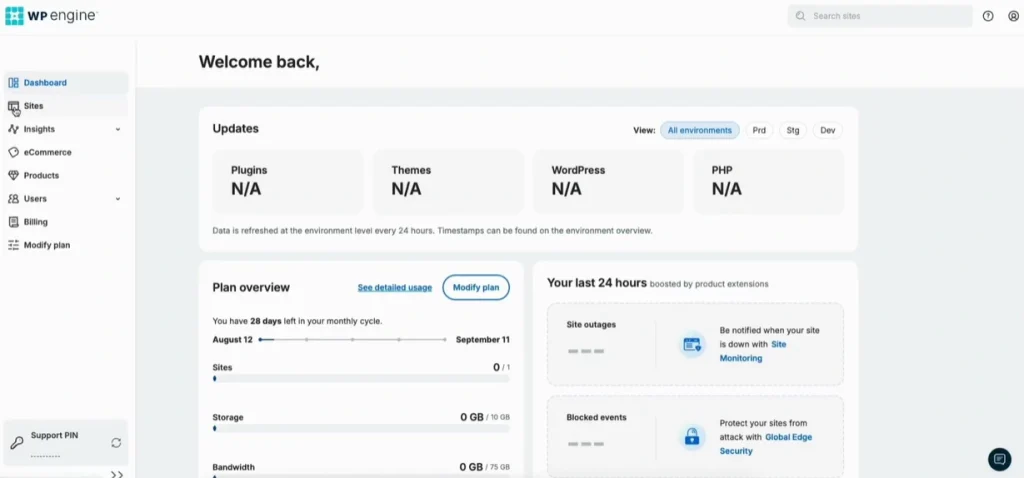
Pressable is simpler from the beginning. WP Engine gives you more tools and flexibility, but the dashboard can feel heavier if you are not used to managed hosting platforms.
Dashboard Experience
Pressable keeps the dashboard clean and straightforward. Most important options like following are easy to find without digging through multiple menus.
- Backups
- Staging
- CDN
- Site management
- SSL
- Team collaboration

The platform is designed for people who want to manage WordPress sites without dealing with too much technical complexity.
WP Engine’s dashboard is more developer-focused. You get more controls, environments, workflow tools, and deployment features, but it also means there are more moving parts compared to Pressable.
Website Setup
Pressable makes website setup very simple. Launching a new WordPress install only takes a few clicks, and the overall onboarding is beginner-friendly.
WP Engine is still easy to use compared to traditional hosting, but the setup process is more structured around environments and workflows rather than simple “launch and go” hosting.
Staging Environments
Pressable includes smart staging environments directly inside the MyPressable dashboard. You can:
- Clone websites
- Create staging copies
- Test updates safely
- Push changes without affecting the live site
The process is straightforward even for non-developers.
WP Engine is stronger for advanced staging workflows. Each site can include:
- Production
- Staging
- Development
environments separately inside the User Portal. This setup is much better for agencies and developers managing ongoing projects or larger client websites.
Backup Management
Pressable handles backups automatically in the background. File backups run daily, database backups run hourly, and restoring a site is very simple from the dashboard.
WP Engine also makes backup management easy with restore points, downloadable backups, and one-click recovery tools. The interface is slightly more technical but gives better control for larger workflows.
Developer Experience
This is where WP Engine starts pulling ahead.
WP Engine supports:
- Advanced staging workflows
- Git integration
- Local development tools
- Environment-based deployments
- Better development workflows
Their Local development tool is especially useful for developers working on client projects or testing changes offline before deployment.
Pressable includes developer tools too, including:
- SSH access
- WP-CLI
- Git integration
- Staging environments
but the overall experience is more streamlined and less developer-heavy.
Customer Support
Customer support is one of the biggest reasons people pay for managed WordPress hosting instead of using cheaper shared hosting.
Both Pressable and WP Engine offer premium-level support, but the experience is very different once you actually start contacting them regularly.
Pressable is more personal and WordPress-focused. WP Engine is more technical, structured, and enterprise-oriented.
Support Availability
Pressable provides:
- 24/7 live chat support
- Ticket support
- Phone support on higher plans
Their support team is heavily focused on WordPress-specific issues instead of general hosting troubleshooting.
WP Engine also offers:
- 24/7 live chat
- Ticket support
- Phone support on eligible plans
along with dedicated enterprise support for larger customers.
Support Quality
Pressable support is more approachable and hands-on, especially for non-technical users. The team is usually willing to help with:
- Plugin conflicts
- WordPress issues
- WooCommerce problems
- Performance troubleshooting
- Basic optimization guidance
A lot of users like that the conversations feel less corporate and more practical.
WP Engine support is extremely knowledgeable technically, especially for:
- Performance optimization
- Staging workflows
- Advanced WordPress setups
- Development environments
- Enterprise troubleshooting
The team clearly understands complex WordPress environments very well, but newer users sometimes feel the platform expects a bit more technical understanding from the customer side.
Response Times
Pressable usually responds quickly through live chat, especially for standard WordPress support requests. Simpler issues often get resolved without too much back-and-forth.
WP Engine also responds fast, particularly on higher-tier plans. Technical escalation and advanced troubleshooting are generally handled very efficiently.
For urgent problems, both platforms perform much better than budget hosting companies.
WooCommerce Support
Pressable is especially comfortable helping WooCommerce users because of the Automattic ecosystem connection. Smaller and medium ecommerce stores usually get very practical support for:
- Checkout issues
- Plugin conflicts
- Store performance
- WordPress-related troubleshooting
WP Engine also supports WooCommerce strongly, but the support style is more performance-focused and infrastructure-oriented.
Documentation and Knowledge Base
Pressable keeps its documentation simpler and easier to follow for regular WordPress users.
WP Engine has a much larger documentation system with deeper technical guides covering:
- Development workflows
- Deployment
- Caching
- Security
- Performance optimization
- Enterprise configurations
Developers and agencies usually benefit more from WP Engine’s documentation depth.
Scalability
Scalability is where the gap between Pressable and WP Engine becomes much easier to notice.
For smaller websites, both platforms feel smooth and fast. But once traffic grows, WooCommerce becomes heavier, or multiple client sites start stacking up, the differences in infrastructure and resource handling start showing up.
Traffic Handling
Pressable is built around automatic scaling, which means the platform adjusts resources during traffic spikes without requiring much manual management.
For most business websites, blogs, agency sites, and medium WooCommerce stores, this works extremely well because you don’t spend time worrying about server tuning or resource allocation.
WP Engine also handles traffic spikes very well, but the platform is more structured around controlled scaling and performance management. It performs especially well under:
- High concurrent traffic
- Dynamic requests
- Logged-in sessions
- Large WooCommerce workloads
This becomes more noticeable on larger sites with complex functionality.
Resource Limits
Pressable generally is more relaxed with resource handling on standard plans. The platform is designed more around smooth managed hosting instead of aggressively enforcing tiny resource limits.
WP Engine is stricter with:
- Visitor limits
- Plan usage
- Resource allocation
- Overage tracking
A lot of users notice this once websites begin growing quickly because upgrades and overage costs can appear faster than expected.
WooCommerce Scaling
Pressable scales very well for normal WooCommerce stores and medium ecommerce businesses. Stores with moderate traffic, regular product catalogs, and normal plugin usage usually perform smoothly without much optimization work.
WP Engine starts pulling ahead for larger ecommerce stores with:
- High order volume
- Large databases
- Heavy plugin stacks
- Dynamic search filters
- High checkout concurrency
Its infrastructure and caching layers feel more prepared for demanding ecommerce traffic.
Agency and Multi-Site Growth
Pressable works well for agencies managing multiple client websites because the platform keeps management simple and collaborative. Features like:
- Team access
- Centralized management
- Staging
- Cloning
make handling multiple WordPress sites fairly easy.
WP Engine is stronger for agencies with larger workflows and developer-heavy operations. The platform supports:
- Advanced staging environments
- Development workflows
- Git-based deployments
- Environment management
- Enterprise collaboration
At larger scale, WP Engine is more like a professional development platform than simple hosting.
Enterprise Scaling
Pressable can absolutely support high-traffic websites, but the platform still is more centered around managed WordPress simplicity and automated reliability.
WP Engine clearly pushes harder into enterprise hosting. Larger brands, media sites, membership platforms, and high-scale WooCommerce businesses usually benefit more from:
- Isolated environments
- Advanced caching
- Dedicated resources
- Enterprise support
- Performance engineering
Pricing
Pricing is one of the biggest differences between Pressable and WP Engine.
Pressable is more affordable and predictable for normal WordPress websites, while WP Engine becomes expensive much faster as traffic and resource usage grow.
| Feature | Pressable | WP Engine |
|---|---|---|
| Starting Price | $25/month | $30/month |
| Websites | 1 Site | 1 Site |
| Monthly Visits | 30,000 | 25,000 |
| Storage | 20 GB | 10 GB |
| CDN | Included | Included |
| Free SSL | Included | Included |
| Backups | Included | Included |
| Money-Back Guarantee | 30 Days | No |
| Free Trial | No | No |
Pressable gives better value on entry-level plans with:
- More storage
- Higher visit limits
- Lower starting cost
WP Engine pricing makes more sense for users who actually need:
- Enterprise-level performance
- Advanced developer workflows
- Large WooCommerce scaling
- Heavy traffic optimization
If you’re leaning toward WP Engine, take a look at the current WP Engine deals before you sign up.
Pressable Pros and Cons
Pros
- Very beginner-friendly dashboard and site management
- Strong WordPress and WooCommerce optimization
- Backed by Automattic, which adds trust for many users
- 100% uptime SLA is stronger than most competitors
- Automatic scaling works well during traffic spikes
- Built-in CDN and edge caching included
- Setup process is simple and clean
- Support team is practical and WordPress-focused
- Daily backups and security tools are included
- Good option for agencies managing client sites
- Less overwhelming for non-technical users
- Performance stays stable without heavy optimization work
Cons
- Fewer advanced developer tools compared to WP Engine
- Limited server-level customization
- Smaller data center network
- Not ideal for highly customized enterprise workflows
- Advanced performance tuning options are limited
- Large WooCommerce stores may outgrow the platform faster
- Developer workflow is simpler than enterprise-focused competitors
- Fewer advanced collaboration and deployment tools
WP Engine Pros and Cons
Pros
- Excellent performance under heavy traffic
- Strong developer and agency workflow tools
- Advanced EverCache system performs very well
- Larger global infrastructure and server region options
- Cloudflare-powered CDN integration
- Strong staging and development environments
- Excellent support for large WooCommerce stores
- Enterprise-level security and scalability
- Git integration and advanced deployment workflows
- Very strong documentation and developer resources
- Handles dynamic WordPress sites extremely well
- Better suited for high-scale WordPress projects
Cons
- No money-back guarantee available
- Pricing becomes expensive quickly as traffic grows
- Visitor limits feel stricter than many competitors
- Overage charges frustrate some users
- Dashboard has a bigger learning curve
- Certain plugins are restricted
- Can feel overly enterprise-focused for smaller websites
- Some users may never fully use the advanced features they pay for
Pressable vs WP Engine: Which Is Better for Different Users?
Choose Pressable If
- You want simpler managed WordPress hosting
- You prefer an easier dashboard
- You run small or medium websites
- You manage normal WooCommerce stores
- You don’t want to handle technical optimization
- You want more predictable pricing
- You prefer a more WordPress-native experience
Choose WP Engine If
- You need stronger developer tools
- You run high-traffic websites
- You manage large WooCommerce stores
- You need advanced staging workflows
- You want stronger performance optimization
- You manage complex client projects
- You need enterprise-level scalability
Alternatives to Pressable and WP Engine
If neither Pressable nor WP Engine is like the right fit, there are a few other managed WordPress hosting providers worth considering depending on your budget, traffic, and performance needs.
Kinsta
Kinsta is one of the strongest alternatives for users who want premium performance with a cleaner and more modern dashboard experience. It’s heavily optimized for WordPress and is especially popular among agencies, ecommerce stores, and high-traffic websites.
You can also check this detailed Pressable vs Kinsta comparison and this WP Engine vs Kinsta comparison if you want to see how Kinsta compares directly against both platforms.
Cloudways
Cloudways is a better fit for users who want more flexibility and cloud server control without paying enterprise-level managed hosting prices. It allows you to choose cloud providers like DigitalOcean, Vultr, AWS, and Google Cloud.
If you are considering a more customizable hosting setup, this Cloudways vs WP Engine comparison explains the biggest differences in pricing, performance, and scalability.
WPX
WPX focuses heavily on simplicity, fast support, and strong performance for smaller and medium-sized WordPress websites. A lot of users like WPX because it is lightweight and easy to manage compared to more enterprise-focused platforms.
Check these too: WPX vs WP Engine, WPX vs Pressable
If neither Pressable nor WP Engine matches what you need, there are a few other managed WordPress hosting providers worth considering. You can also check these WP Engine alternatives for more hosting options with different pricing and performance setups.
Final Verdict
Pressable is the better choice for users who want simpler managed WordPress hosting with strong uptime, easier site management, and more predictable pricing. It works especially well for small businesses, agencies, bloggers, and medium WooCommerce stores that want reliable performance without dealing with complicated hosting workflows.
WP Engine is the stronger platform for developers, large WooCommerce stores, high-traffic websites, and businesses that need advanced staging, aggressive performance optimization, and enterprise-level scalability.
So the decision mainly comes down to this:
- Choose Pressable if you want simpler WordPress hosting that stays easy to manage long term
- Choose WP Engine if you need stronger developer tools and higher-level performance infrastructure
For most normal WordPress users, Pressable offers better overall value.
For larger and more demanding WordPress projects, WP Engine delivers stronger scalability and advanced performance capabilities.
FAQs
Is Pressable better than WP Engine?
Pressable is better for users who want simpler managed WordPress hosting with easier site management and more predictable pricing. WP Engine is better for advanced users, developers, and high-traffic websites that need stronger performance optimization and scalability.
Which is faster: Pressable or WP Engine?
Both platforms deliver excellent performance, but WP Engine performs better for larger dynamic websites, high-traffic WooCommerce stores, and developer-heavy projects.
Is WP Engine worth the higher price?
WP Engine is worth the higher price for websites that need advanced developer workflows, enterprise-level scaling, stronger caching technology, and high-performance infrastructure.
Which hosting is better for WooCommerce?
Pressable works very well for small and medium WooCommerce stores. WP Engine is better for larger ecommerce stores with heavy traffic and more complex workloads.
Does WP Engine provide a money-back guarantee?
No. WP Engine currently does not provide a money-back guarantee.
Which hosting is better for agencies?
WP Engine is better for large agencies and advanced workflows. Pressable is better for agencies that want simpler client site management.
Does Pressable include a CDN?
es. Pressable includes a built-in global CDN and edge caching system with hosting plans.
WP Engine and Pressable are both reputable managed WordPress hosting providers, but your choice depends on your needs. WP Engine is known for its robust features, while Pressable offers affordable plans. Evaluate your site’s requirements, budget, and performance needs to determine which is better suited for your WordPress hosting needs.
This blog post comparing Pressable and WP Engine as hosting solutions is incredibly insightful. Your in-depth analysis of their features, performance, pricing, and customer support provides a comprehensive view that’s immensely valuable for anyone seeking the right hosting platform. I appreciate how you’ve highlighted the strengths and potential drawbacks of each option, giving readers a well-rounded perspective to make an informed decision.