
The default WordPress login page doesn’t reflect your brand and is easily targeted by bots. Creating a custom login page gives you a unique login URL and improves user experience.
For better security, you should also hide the default login page so only your custom URL is accessible.
In this guide, you’ll learn how to create a custom login page with LoginPress and secure it by hiding the default login URL.
What is a WordPress Login Page?
WordPress login page serves as a gateway to access a site. The user only needs to type in Email and Password, and they are in.
The default WordPress login page is the same for almost every site. It has:
- Gray Background
- WordPress Logo
- Simple Login Form
This is what it looks like:

Why do you need a custom WordPress Login Page?
Here are some of the most important reasons why you might want to create a custom login page:
- Branding: A custom login page lets you maintain a consistent brand identity with a custom logo, color scheme, etc.
- Security: You can take security measures to boost WordPress security to protect itself against brute force attacks.
- User Experience: A custom login page creates a more user-friendly interface.
- Functionality: You can improve the overall functionality of the login page by integrating additional features, i.e., social login options, custom welcome and error messages, and much more.
- Differentiation: A custom login page helps set your WordPress site apart from others using default WordPress login pages.
This is what a custom WordPress login page looks like:

How to Create a Custom WordPress Login Page using LoginPress
You can easily create a custom WordPress login page, i.e., manually or using a plugin.
The manual work needs coding, which is way more complicated. However, it’s pretty simple to do it via a WordPress plugin.
There are several WordPress login page customizer plugins available for free and premium. Here, we’ll show you how to do it with LoginPress easily.

LoginPress is the best WordPress login page customizer plugin that simplifies the process of creating a custom WordPress login page. It provides various design options without needing coding skills.
The best part is that everything is done straight from your WordPress admin dashboard.
Step 1: Install and Activate LoginPress
To create a custom login page with LoginPress, you must first install and activate LoginPress on your WordPress site.
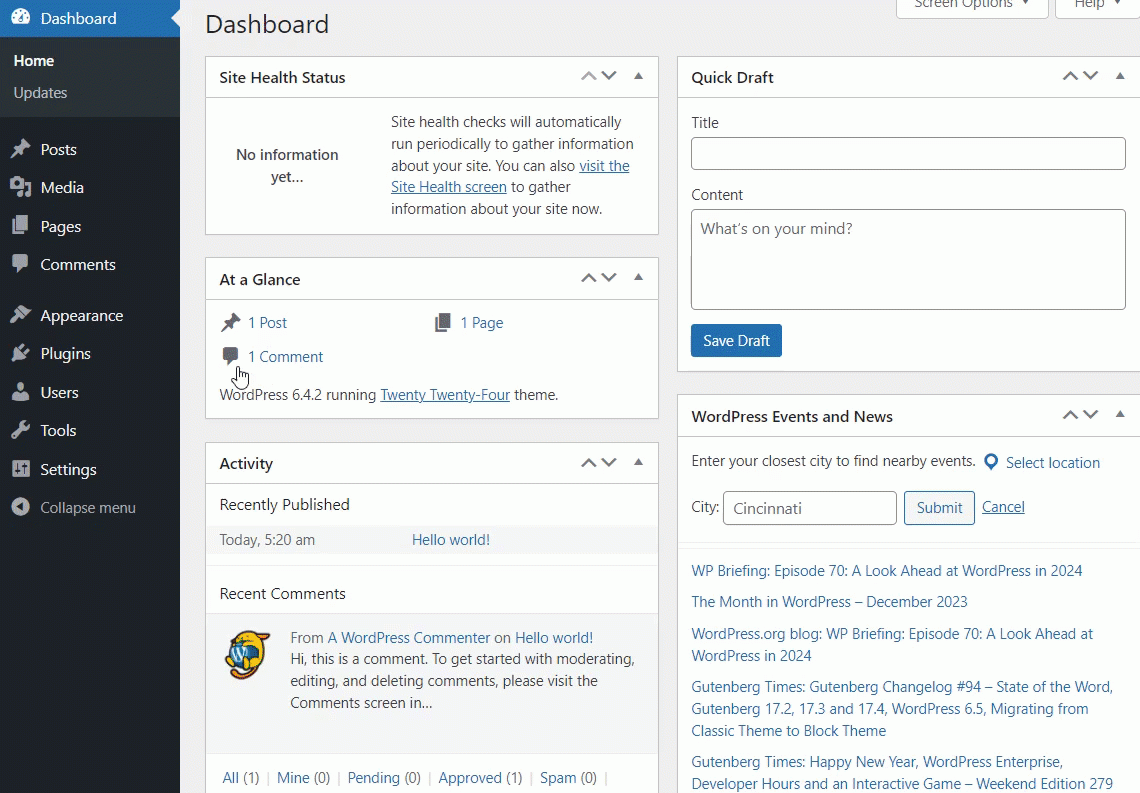
For this purpose, go to the left sidebar of the WordPress admin dashboard > navigate to Plugins > Add New.
On the next screen, search for the LoginPress in the search bar > find the plugin from the search results > click the Install Now and then Activate button.
See the Image below.
Step 2: Start Customizing your WordPress Login Page
Now, you are ready to customize your WordPress login page. Let’s get started!
1. Customizable Login Page Theme
LoginPress offers beautiful themes for the default WordPress login page. You can select the one that best aligns with your taste.
Note: You can easily unlock wonderful other themes for your site with LoginPress Pro.
See the Image below:

2. Custom Login Page Logo
LoginPress lets you swipe the default WordPress login page logo. It helps you add a personal touch to your login page.
After adding a logo, you can bring changes to it in terms of:
- Logo Image
- Logo Width
- Logo Height
- Space Bottom
… and more.

3. Custom Background Color / Image/ Video
Whether it’s a captivating image, a solid color scheme, or a dynamic video, LoginPress ensures that the background enhances your brand’s aesthetics.

4. Customize Login Form
LoginPress allows you to fine-tune the login form according to your specifications. This makes it more user-friendly and maintains visual coherence with your brand’s style.
See the image below:

5. Custom Log In Buttons
LoginPress enables you to create stylish and eye-catching login buttons that prompt action and seamlessly blend with the overall design.
You can easily add:
- Button Color
- Button Border Color
- Button Color (Hover)
- Button Border Color (Hover)
- Button Size
- Botton Text
… and whatnot.
See the image below:

6. Custom Error and Welcome Messages
LoginPress lets you create custom error and welcome messages for the users.
The Error Messages cover a wide range of actions for the default WordPress login page, such as:
- Incorrect Username Message
- Incorrect Password Message
- Empty Username Message
- Empty Password Message

Besides this, custom Welcome Messages allow you to greet users on the login, register, and forget forms.
See the image below:

7. Custom Form Footer
No doubt, a custom form footer can complement the login form. It helps you provide additional information or reinforce your brand message.
This is where LoginPress again jumps in to change the login form footer area and also add copyright notes to the default WordPress login page.
See the image below:

8. Customized Google Fonts
You can easily select handpicked Google fonts with LoginPress Pro that resonate with your brand.

9. Custom CSS/JS
LoginPress offers a custom CSS/JS feature to help you fine-tune the visual elements exactly how you want for the login page that is missing as the plugin’s core functionality.

10. More Features
Other than customizing the default WordPress login page’s overall look and feel, you can easily change the default WordPress login page’s default behavior using a wide variety of LoginPress Features.
For example, you can:
- Force Password Reset: The plugin enables you to force a password reset for the users after the set duration.
- Session Expire: You can create a custom time for session expire, i.e., 10 minutes.
- Auto Remember Me: This feature helps you to keep the default WordPress Remember Me option always checked for the login form.
- Custom Password Fields: Add custom password fields to the default WordPress Register form.
- Login Order: With LoginPress, you can change the default WordPress login order, i.e., Username and Email Address, Only username, or Only Email Address.
- PCI Compliance: Now you can make your login page PCI Compliant with LoginPress with just a single click.

Besides this, you can unlock useful Add-Ons with LoginPress Pro to get other exciting features for your login page, such as:
- Login Logout Menu: This free Add-on lets you create a login/logout menu for your site.
- Login Redirects: You can use this Pro Add-on to redirect users to the desired page of your site on login/logout.
- Social Login: LoginPress Pro Social Login Add-on lets you add social login, i.e., Facebook, Twitter, Google, and LinkedIn, to your site.
- Login Widget: You can easily add a login widget to the sidebar of your WordPress site to add an additional login to your site.
- Limit Login Attempts: This Add-on lets you limit login attempts for your site. It best helps against cyberattacks.
- Auto Login: LoginPress Pro Auto Login Add-on enables you to create a magic link that users can use to access your site without needing any Username and Password.
- Hide Login: This Add-on lets you change the default login URL, i.e., /wp-login.php, and make it something only you know. It is the best way to hide your login URL from the cybercriminals.

Hide Default WordPress Login Page (Important Step)
After creating your custom login page, the next step is to hide the default WordPress login URL. If you keep /wp-login.php accessible, your site is still exposed to bots and brute-force attacks.
There are two ways to hide your WordPress website login page from hackers as mentioned below.
- Change your WordPress login URL
- Hide your wp-admin and wp-login page
1. Change Your WordPress Login URL
It is simple to identify whether your website is WordPress powered or not. Once a hacker sees that your site is powered by WordPress, it is pretty easy for them to find your login URL. the default WordPress login page is found by entering your domain name, followed by /wp-login.php.
Most of the site owners do not change their username after they set up a blog from its default username which is [admin].

With enough hits at your site, hackers can easily arrive at your correct password as the rest of the details are already given. To prevent hackers and malicious bots to land on your site’s login page, it is best to change your login URL from something which is very obvious to something unpredictable.
Changing the WordPress login URL might not prevent hackers to break into your site but it will definitely avoid mischievous visitors and random bots to land up on your website login page. One way to do it is to consider installing WordPress in a subdirectory. Before moving an existing installation, make sure you create a complete backup of your site and store it somewhere where you don’t accidentally delete or modify it. You can use the best backup plugin to back up your WordPress site.
Instead of choosing predictable names like http://example.com/wordpress or http://example.com/wp, choose a name that is unique and not so obvious like http://example.com/wpid.
2. Hiding Your Site Login Page
The next logical step to encourage your security is to hide your login page from hackers and malicious bots. If your site is of the nature that it has to be easier for multiple users to find and log in then it’s best that you consider this step with caution.
It is not recommended to use the strategies given below if your site is a membership site and login attempts are open to a larger array of users.
There are two basic ways to hide your site’s login page:
- Using plugins
- Using wp-login.php file (without plugins)
1) Hiding the login page using a plugin
WordPress offers an array of plugins that can be used to hide your login page URL. Some of the plugins also allow you to hide your website login page and redirect wp-login.php users to another page of your website. Visit WordPress.org Plugin directory and search for “Hide WP Login” to see a list of security plugins that you can use.
Here is a list of plugins that can be used for this purpose:
Once you download and install a plugin activate the plugin. Different plugins have different methods to hide the login.
Using the “WPS Hide Login” Plugin
WPS Hide Login is one of the best plugins to hide your WordPress login page. It lets you specify a new custom login URL and blocks all traffic to the default wp-admin and wp-login pages. It’s the quick and dirty way because setup pretty much takes two seconds.
All you need to do is specify your new login URL by going to Settings —> WPS Hide Login and the plugin takes care of the rest.

Using the “Defender” Plugin
Defender works a little bit differently in terms of the interface but pretty much uses the same method. Once you activate the plugin and finish the setup, the Defender plugin allows you to access its Advanced tools options.
Follow the simple steps to hide your login URL:
- In the masking URL section of the advanced tool screen, you can enter a new URL slug where your site users will go to log in or register on your site.
- Save your changes and log out of your WordPress site.
- Now, log back in via the default login page at yourdomain.com/wp-login.php. You will see that defender blocks user who does not have access to the masked URL. Anyone that tries to visit the default WordPress login page (i.e. wp-login.php) will be greeted with an error message (“This feature is disabled”). Users who have access to the masked URL will only be able to access the login page.
Redirect Users to a different page of your website
Plugins also have a redirect traffic feature that can be used to send visitors to a different page on your website. You can do this by going back to the Advanced tool Screen of the Defender. Enable 404 Redirection in the Redirect traffic section. Then enter the slug of the page you want to send visitors to. And then click Save Changes to update your settings.
2) Hide your Login URL without a plugin
You can easily hide your login page from hackers without using a plugin. This can be done using your installation files and text editor.
- It is best that you make a backup of your wp-login.php file. It will avoid any damages you do while editing it. Once you are done, open your wp-login.php file and copy everything to your clipboard.
- Create a new file using your text editor. Paste the code from your existing wp-login.php file into your new file and save. Alternatively, open your wp-login.php file and ‘save as’ your new filename.
- Search and replace every instance of ‘wp-login.php’ in the code with your new login filename. Save the file again.
- Log into your server and upload the new login file to the root folder or directory where you have installed WordPress. Delete the original wp-login.php file from your server.
- Test your new login page URL. Anyone visiting the default wp-login.php page will experience an error.
Conclusion
Creating a custom WordPress login page helps you improve branding and user experience while giving you a unique login URL. It replaces the default design and makes your site look more professional.
For better security, hiding or changing the default login page is equally important. This ensures that only your custom login URL is accessible and reduces unauthorized access attempts.
By combining both steps, you create a more secure and controlled login system for your WordPress site.
How far have we helped you create a custom WordPress login page? Let us know by leaving a comment in the comment section below.
About Author
Muhammad Adnan is the founder of WPBrigade, a WordPress web design and development company. He established WPBrigade with a specialization in WordPress development, providing customized solutions to meet clients’ specific requirements.
It’s good to read your article. It’s great because I also have a WordPress site. Thanks for your sharing.
Reading your post was enjoyable. I have a WordPress website as well, so that’s awesome. Thank you for sharing.
This post was amazing to read, I have also a wordpress website, that was very helpful. Thanks for sharing.